A Family Affair: How Ballet West's Parent-Dancers Are Redefining Life in the Studio
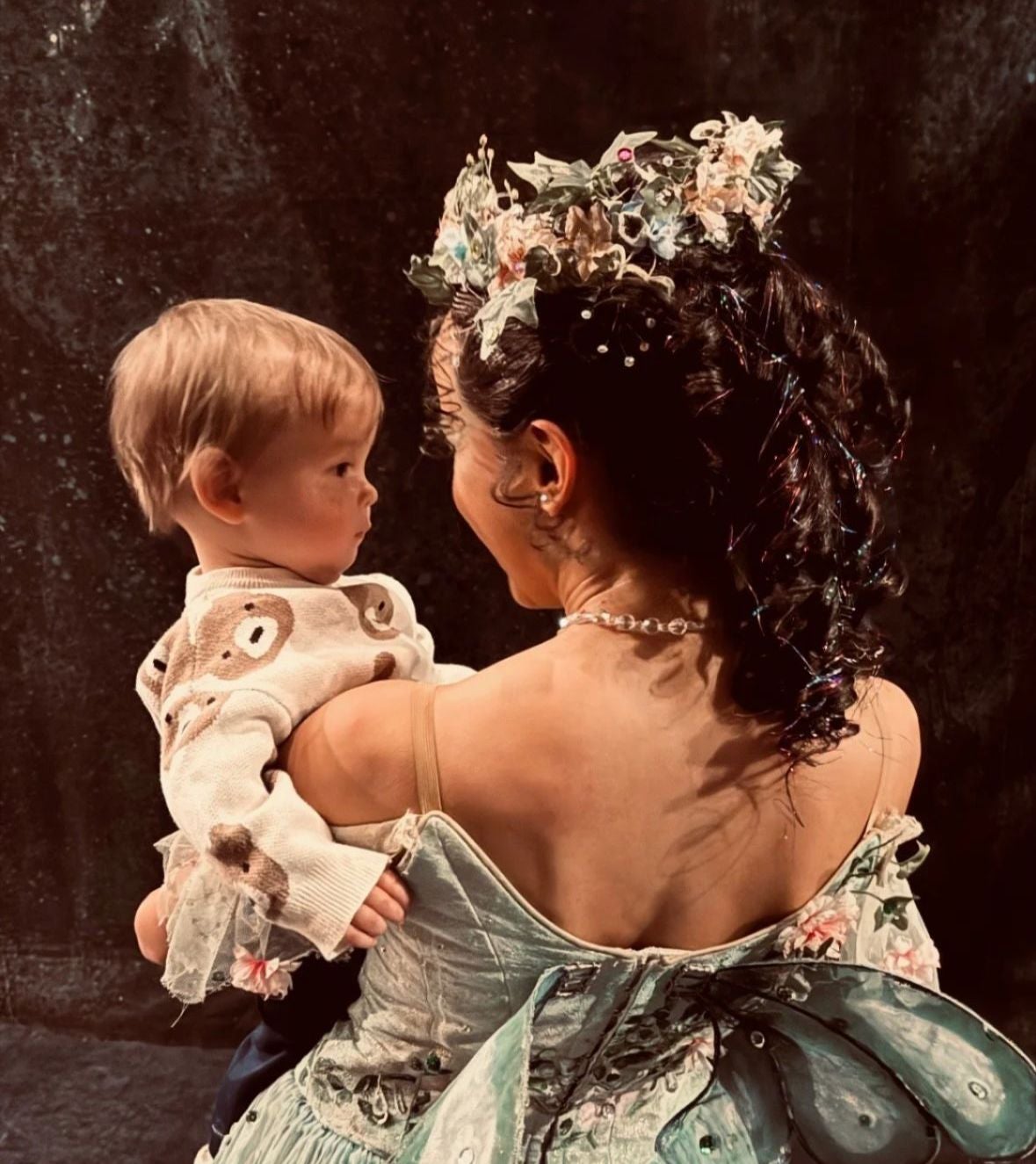
When Principal Artist Jenna Rae Herrera’s son refused a bottle during The Nutcracker season, her husband started bringing the baby to the studio. She’d nurse him during breaks between rehearsals, then return to the studio preparing for her role as Sugar Plum Fairy.
For Principal Artist Jordan Veit, dancing the grand pas de deux in The Nutcracker with a newborn baby at home meant performing on less sleep than he was used to, so he learned to rely on his years of training.
This is what professional dancing and parenting looks like, up close.
Five of Ballet West’s principal artists are parents. Principal Artist Adrian Fry and his wife, a former Ballet West dancer, have three children ages five, three, and one. Principal Artist Emily Adams and her husband, former First Soloist Beau Pearson, have two children, ages six and one.
Both Veit, married to a former professional dancer, and Principal Artist Tyler Gum, married to former Demi-Soloist Olivia Gusti, welcomed children in the past year.
Herrera, married to former Ballet West Soloist Alexander MacFarlan, returned to the stage at the start of last season. So did Adams — both navigating the demands of a full performance schedule with newborns at home.
What they’ve navigated may look different, but what they have in common is a company that has worked to make it possible. Years before the current generation of parent dancers joined the company, Ballet West was already building a culture where a dancer could have a child and still have a career.
Former dancers like Katherine Lawrence and Allison DeBona did exactly that, at a time when a dancer’s parenthood wasn’t yet widely accepted in the professional dance world. The contract negotiations that followed were possible in part because Ballet West already believed in the principle.
Leaving Room for Family
In he professional dance world, parental leave is far from standard. Dancers who become parents often have to arrange terms within their contract or hope for goodwill from their company. Ballet West took a different path, but it didn’t happen on its own.
Veit spent six years as an American Guild of Musical Artists (AGMA) delegate and was part of the effort that pushed parental leave into the company’s contract. Gum also helped advocate for it before he was even married. Fry stepped in as well, making the case that the original allowance simply wasn’t enough. Through multiple rounds of negotiation, the leave increased and was structured in a way for dancers to use it flexibly.
Gum explained his reasoning behind the efforts. “That’s one of the biggest life changes you can make as a person.” He thought about the fathers he knew and realized he didn’t want that for his family or for anyone else in the company.
What surprised all five of them, in ways they hadn’t anticipated, was the impact parenthood had on their dancing.
Trusting Their Training
Fry sed to come into the studio on extra days before having kids. He’d take classes and work through choreography. “There’s just no chance for that anymore,” he said. What he found instead was that he didn’t need it. “I realized what I’m doing is enough, and it’s good.” Some days he leaves the theatre still in his ballet clothes, wanting to spend all of his extra time home with his kids.
Veit made the same discovery. He no longer stays after rehearsal to run things through his head. He works hard while he’s there, and then he leaves work at work. It’s changed how he thinks about readiness.
"As dancers, we don’t know if we’ve rehearsed enough,” Veit says. “We tell ourselves we don’t feel ready for the stage, but it’s similar to having a baby. You never actually feel ready until you’re out there, and then you’re like, oh, I do know how to do this.”
A Different Body
When Herrera discovered she was pregnant near the end of the 2023 - 24 season, she continued performing with the company through the first 16 weeks of pregnancy and kept taking technique classes up until her third trimester. At about three months postpartum she began working with a pelvic floor therapist through an exercise regimen called Gyrotonics to help feel connected to her body again.
Pregnancy and labor just completely disrupted that; I had no control of my body whatsoever. I’m sure most other mothers can recognize that feeling,” she said.
She returned to the company full-time last August, where she prepped for the role of Titania in A Midsummer Night’s Dream, something she had dreamed of her entire career. Then, during the month her son turned one, she performed the role of Sugar Plum Fairy. “I think back to last year, when I could barely walk after having him, to now,” she said. “A woman’s body is amazing.”
While she has never been more exhausted, Herrera said she has never had so much joy in her life. She jokes that she doesn’t get to have her pre-show nap as often anymore, but she is just taking it one day at a time while trying to be as present as possible wherever her feet are.
"When I go home, I am immediately a mom, and taking care of my son is top priority. But that makes it all the sweeter when I come to the theatre because I get to dance, and it’s something beautiful that I get to experience and also share with my son,” Herrera said.
"It was not easy, but Ballet West is such a supportive environment for mothers,” she continued. “Our Artistic Director, Adam Sklute, was so patient and gracious. He said, ’Come back at your own time, whatever you need to do ... we’re here to support you.’ I really felt encouraged and celebrated.”
A New Kind of Meaning
For Adams, becoming a mother reframed how she thought about dance.
Before her first pregnancy, she had begun questioning whether ballet was meaningful and wondering what she was actually contributing. Then, when theatres closed during COVID and she was pregnant with her first child, something shifted.
"I want him to grow up in a world where you go to the theatre and see beautiful dancing and hear beautiful music,” she said. “If that’s the gift I’ve been given, I knew I wanted to keep sharing it with the world.
Adam admits that returning to work as a professional dancer after pregnancy is not easy.
"It's physically painful,” she said. “It’s also really hard psychologically because you’re used to feeling and looking a certain way.” But she kept going. “I realized how much I love it even more after having kids. It’s given me an identity outside of being a dancer that I think is really healthy. And it’s made me realize the value of it more.”
Gum finished his bachelor’s degree this spring while dancing full time and raising his son, now 11 months old. While he was certainly busy, it made him think about the future differently.
"I know my son is going to watch what I do. That’s made a difference in my work ethic,” Gum said. “I also want to show my son how to fight for the things that really make you come alive, since dance has been that for me.”
Somewhere between the late nights, nursing breaks, and less-than-perfect naps, these five dancers have discovered that while the studio may look the same, what they bring to it has changed.